
Tucson did everything right. So did the destinations that lost hotel blocks in cities like Philadelphia and Mexico City. The question the sports tourism industry needs to answer: who bears the risk when mega-events don’t go as planned?
THE SETUP
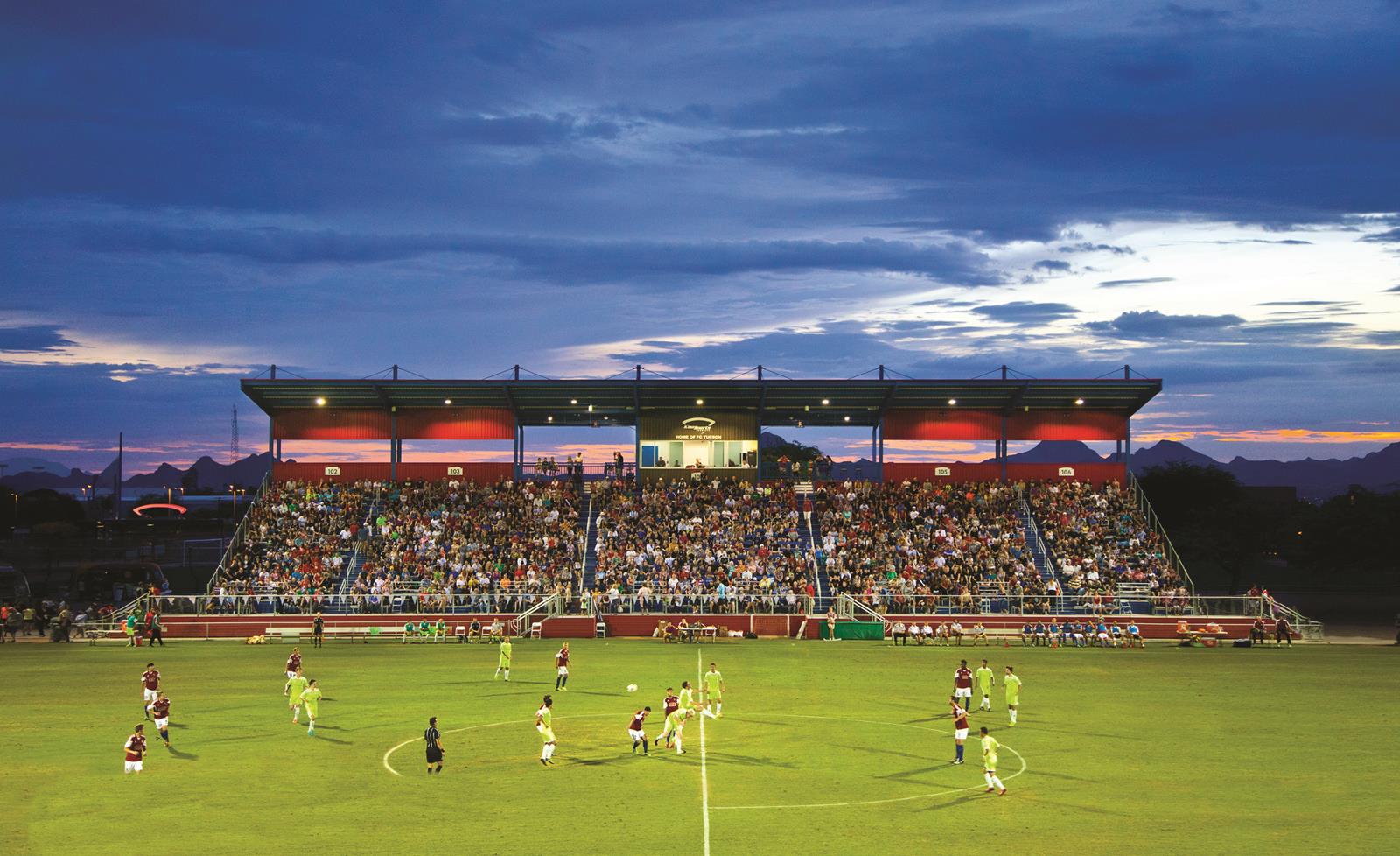
Twenty months of preparation. Twenty-two soccer fields brought to FIFA standards. Security contracts signed, grounds crews finished, 241 hotel rooms reserved at the Westward Look Resort for a 30-day buyout. Pima County and the Kino Sports Complex in Tucson had done everything asked of them to host Iran’s national soccer team as a World Cup training base camp this June.
Then Iran moved to Tijuana.
The reasons were understandable. Visa processing delays left key members of Iran’s football federation staff without U.S. travel documents. Geopolitical tension surrounding the ongoing war added security uncertainty. FIFA approved the relocation. Tijuana offered proximity to Iran’s group-stage matches in the Los Angeles area. The team’s arrival in Mexico made logistical sense.
What it left behind in southern Arizona was the bill. Pima County had spent more than $75,000 on security and local contractors. Westward Look Resort stood to lose hundreds of thousands of dollars on the room block alone, plus three catered meals a day for the team. County officials estimated the combined anticipated economic impact at roughly $13 million when accounting for this and a previous lost opportunity.
“We were 98 percent complete,” said Sarah Hanna, director of Kino Sports Complex. “We started heavily preparing the facility once we were awarded a team.”
Pima County Supervisor Matt Heinz was more direct. “We didn’t do anything. This wasn’t because the county screwed up, or the sports complex was inadequate. That’s what’s so frustrating.”
He was right on both counts. And that is precisely the problem.
THE STRUCTURAL PROBLEM
Tucson’s experience is not an isolated misfortune. It is a window into how financial risk is distributed in the modern mega-event framework.
Across the same 2026 World Cup tournament, FIFA canceled 2,000 of its 10,000 reserved hotel rooms in Philadelphia, exercising a last-minute opt-out clause with no reported penalty. In Mexico City, FIFA canceled 40 percent of its hotel reservations. Host cities across the United States, including New Jersey, Boston, Miami, and San Francisco, scaled back or eliminated planned fan festivals after federal security funding stalled. The pattern is consistent: destinations invest, commit, and prepare. Event organizers retain the flexibility to adjust.
The contractual basis for this imbalance is well established. A peer-reviewed legal analysis published in The International Sports Law Journal found that FIFA’s host city agreements shift extensive liabilities onto the host city while reserving expansive powers for modification. Host cities cover operational costs. FIFA controls the terms. Destinations that attempt to alter their contractual obligations risk breach of contract claims under Swiss law, which governs FIFA agreements.
The Kino Sports Complex base camp arrangement carried its own set of agreements, brokered through Visit Tucson and the Southern Arizona Sports, Tourism, and Film Authority. Whether those agreements included meaningful withdrawal protections or financial penalties for team relocation has not been publicly disclosed. What is clear is that Pima County absorbed the cost.
This is not a new phenomenon. When Chicago and Vancouver declined to pursue hosting bids for the 2026 World Cup, both cited contract terms that placed unknown financial risk on the host city while giving FIFA broad authority to modify agreements at any time. Chicago’s representative called FIFA’s position one of “inflexibility and unwillingness to negotiate.” British Columbia’s tourism minister described the provisions as creating “unknown costs and unknown risks to taxpayers.” Those cities made a calculation. Tucson, working in good faith toward a once-in-a-generation opportunity, made a different one.
THE INFRASTRUCTURE GAP
The cruelest part of the Tucson story is that the Kino Sports Complex is genuinely world-class. The facility spans more than 300 acres, includes 22 soccer fields, hosts USL League Two competition, and has a track record as a professional spring training site. It took 18 months to earn FIFA’s base camp designation. Its selection was a validation of years of investment by Pima County and the regional sports tourism community.
None of that protected it from what happened.
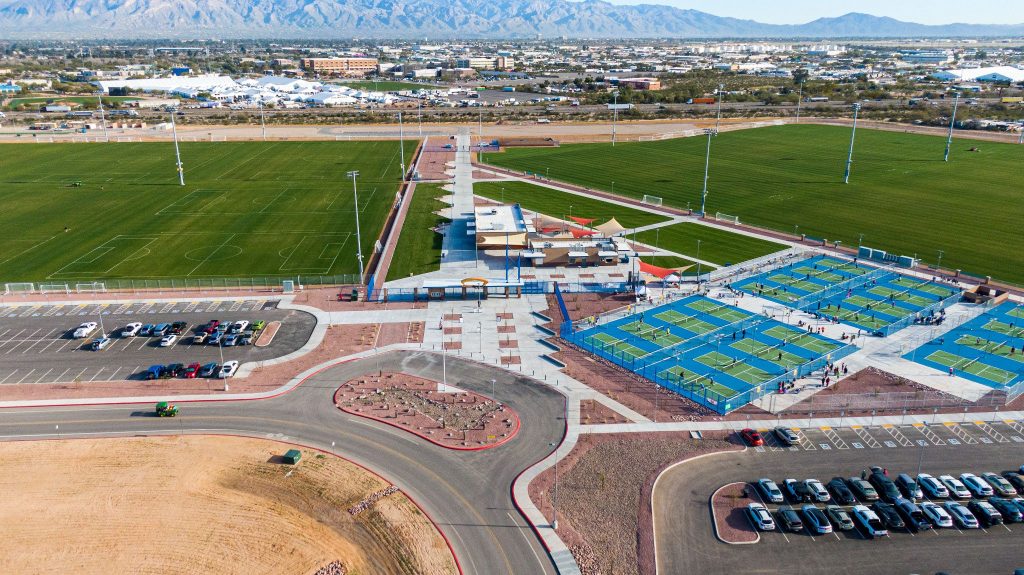
This is the infrastructure gap the sports tourism industry is not discussing loudly enough. Facility quality, room block capacity, airlift access, public safety infrastructure: these are the variables destinations have spent the last decade optimizing. And they matter. But they do not address a different category of risk that has moved to the front of the line. Geopolitical disruption, federal visa policy, and event organizer contractual flexibility can override every investment a destination makes in its physical product.
The World Cup is the most visible example, but it is not the only one. The United States is entering a decade of concentrated mega-event activity. The 2028 Los Angeles Olympics, expanded College Football Playoff rounds, growing NCAA championship footprints, and NFL international series growth are all bringing large-scale event infrastructure decisions to destinations across the country. The legal and financial frameworks governing those events carry similar dynamics. International organizing bodies hold modification rights. Host cities hold the operational costs.
Bid strategy has matured significantly over the past decade. Sports commissions have become sophisticated evaluators of hotel inventory, transportation logistics, and community engagement. What has not kept pace is risk management language in the contracts those commissions sign.
WHAT THE INDUSTRY SHOULD BE ASKING
For sports commissions and CVBs evaluating future mega-event bids, the Tucson situation offers a concrete set of questions worth stress-testing before any agreement is signed.
The first is the most basic: what are the withdrawal provisions? If a team relocates, if an event anchor pulls out, if a sanctioning body exercises its modification rights, what financial obligation does the event organizer carry to the host destination? A contract with no meaningful penalty for early departure is a contract that places all the risk on one side.
The second question involves sunk costs. Security contracts, facility upgrades, staffing commitments, and field preparation are real expenditures that begin well before any event arrives. Whether those costs are recoverable in a relocation scenario should be a negotiated term, not an afterthought.
Third, event cancellation insurance has evolved alongside the mega-event industry, but coverage terms vary widely. A policy that covers weather events or natural disasters may not address geopolitical force majeure. Destinations committing to international base camps and event agreements should verify what their coverage actually includes, and push to close the gaps.
Fourth, legal review is not optional. Chicago’s decision to walk away from a World Cup hosting bid came after its legal and financial team analyzed the terms. Not every destination has that capacity in-house, but the cost of outside counsel to review a multi-million-dollar event agreement is modest relative to the exposure that agreement creates.
Fifth, and perhaps most importantly, the industry needs a broader conversation about reciprocal commitment. Destinations are asked to make binding, expensive, years-long preparations. The expectation of comparable commitment from event organizers is reasonable, and it is a position that collective advocacy through organizations like Sports ETA is well positioned to advance.
MOVING FORWARD
Pima County’s response to the Iran relocation was measured and forward-looking. “The amount of collaboration with our partners and the planning that went into this reinforces that Pima County and Kino Sports Complex have the ability to host events of this magnitude,” Hanna said in a statement following the announcement. The county is right. What Tucson built is real. What it proved is real. The loss is real too, and it was not earned.
The destinations that thrive in the mega-event era ahead will not simply be the ones with the best facilities. They will be the ones that learned to read the contract as carefully as they prepared the pitch.
| BEFORE YOU SIGN Five questions every sports commission should ask before committing to a mega-event base camp or hosting agreement 1) What are the team or event withdrawal provisions, and is there a financial penalty for early departure? 2) Are your sunk preparation costs recoverable if the event relocates? This includes security contracts, facility upgrades, and staffing commitments. 3) your cancellation insurance cover geopolitical force majeure events, or only weather and natural disaster? 4) Who holds modification rights in the agreement, and under what conditions can the event organizer alter commitments unilaterally? 5) Has legal counsel with sports event contract experience reviewed the full agreement before your organization signed? |