
Youth tournament sports grew from a passion project run by former coaches on borrowed fields into a $128 billion economic engine. Understanding how we got here is the only way to understand where we’re going.
In the Good Old Days
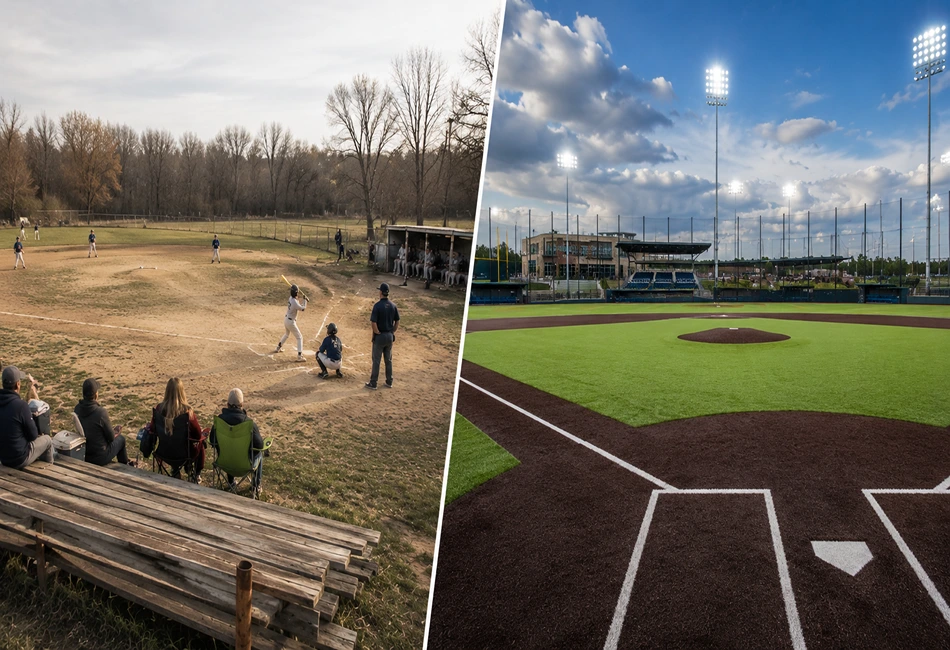
The gym smelled like old sneakers and concession-stand popcorn. The fields had bare spots in the infield, and the dugouts were chain-link fences nailed to wooden posts. The tournament director, usually a former coach, ran the whole operation from a folding table near the entrance, cash box at the ready, hand-drawn bracket taped to a whiteboard behind him.
This was youth tournament sports in America, circa the 1990s. The events were local. The entry fees were modest. The competition was local. And the people organizing them did it primarily because they loved the game.
Parks and recreation departments provided the fields. High school gymnasiums hosted basketball brackets. Local umpires worked the field. Families brought lawn chairs and packed lunches. If grandma and grandpa were in town, they came too. The economic footprint rarely extended beyond the nearest diner.
That world still exists in pockets across the country. But it is no longer the dominant model. Understanding the arc from those folding-table operations to today’s institutional capital environment is essential for every destination, rights holder and tournament operator doing business in the modern sports tourism economy.
Sports event planning moves fast, and the best venues book early. Subscribe to Sports Planning Guide for free destination features, facility news, and planning resources delivered straight to your inbox.
Where the Premium Experience Began
Before private equity arrived, before bond-funded mega-complexes became a standard line item in municipal economic development budgets, two independent operators had already proved that families would travel far and spend significantly for the right youth sports experience.
In 1999, Martin and Brenda Patton, a local business couple in upstate New York, conceived what would become Cooperstown All Star Village. Their vision was specific: give 12-and-under baseball players a once-in-a-lifetime experience in the birthplace of the game, complete with major league-caliber fields, national competition and the kind of atmosphere most kids only see on television. The gates opened in 2004. What followed exceeded anything the Pattons had modeled. Teams from across the country began booking a year in advance. Families planned vacations around it. The tournament did not just host an event; it created a destination.
Around the same time, Cal Ripken Jr. was building a parallel vision in Aberdeen, Maryland. The Ripken Experience brought professional facility standards to the youth level, with manicured fields, stadium lighting and an operational quality that set an entirely new expectation for what a youth baseball tournament could look and feel like. Ripken eventually expanded to Myrtle Beach, Pigeon Forge and Elizabethtown, each facility carrying the same commitment to what the organization called a Big League Experience for young players.
Neither operation began as a business thesis. Both began as a belief that young athletes deserved better than what the park district was offering. But in demonstrating that families would reliably invest significant time and money for a premium experience, Cooperstown and Ripken did something consequential beyond their own markets: they proved the demand existed at a scale that eventually attracted an entirely different class of investors.
Martin and Brenda Patton sold Cooperstown All Star Village to Unrivaled Sports in 2022 for $116 million. The experience they built from scratch for the love of the game had become, in the language of institutional capital, a premium experiential asset with a national brand and a defensible market position. That transaction, more than any spreadsheet or market analysis, is the story of how youth sports arrived at this moment.
Cooperstown All Star Village growth timeline: team volume from 2004 to 2026, showing expansion from 200 teams at opening to 1,350 teams in 2026, with the Unrivaled Sports acquisition in 2022 marked as a key inflection point.
Then Came the Shift
Sports Planning Guide has been tracking the growth of purpose-built multi-sport facilities by the mid-2010s when the signals were unmistakable. Anyone positioning this story as a recent phenomenon missed the first act entirely.
Families were driving and then flying further for events. Sanctioning organizations including USSSA, AAU, USA Baseball, USA Softball and NSA had established national circuits with rankings, championships and enough competitive gravity to pull teams across state lines every weekend.
The market for youth team, league and tournament sports reached $24 billion globally by 2018, tracking toward $28.7 billion by 2019, numbers that caught the attention of people well beyond the world of youth athletics.
Why? Youth tournament sports checked every box that institutional investors look for. A fragmented market ripe for consolidation. Recurring seasonal revenue. High family loyalty and re-enrollment rates. Thousands of small independent operators with no dominant national player. Sprinkle in a total addressable market growing faster than the broader economy and the question was never whether capital would arrive, the question was when, and in what form.
A Carriage Industry Finds its Automobile Moment
For most of its history, the youth tournament sports industry resembled what economists call a carriage industry: a sector where the dominant model is deeply embedded, widely understood by its participants and entirely unexamined as a business structure. The people running tournaments were coaches and parents who had found a way to make the sport they loved into something sustainable. Their competitive advantage was passion, local relationships and institutional knowledge of the game itself.
What they were not, by and large, were operators in the business sense. Revenue management, yield optimization, multi-destination booking strategies, hotel room block negotiation, facility exclusivity clauses: these were foreign concepts to the founding generation of tournament directors. And that was fine, because the industry’s buyers, families and park districts, operated at the same level of informality. It was a handshake economy, and it worked.
But handshake economies have a vulnerability: they depend entirely on the people whose hands are shaking. When the founding generation of tournament operators began to age out, and they have been doing so steadily for the better part of a decade, two things happened simultaneously. The relationships those operators carried walked out the door with them, and the businesses they built became available for acquisition at prices that looked very attractive to buyers with institutional capital and a consolidation thesis.
This generational transition is the structural condition that made private equity’s entrance into youth sports not just possible, but predictable. It is the same dynamic that reshaped the veterinary industry, the dental industry and dozens of other fragmented service sectors before this one.
Want more destinations and venues like this one? Sign up for Sports Planning Guide and get event-ready host cities, facility guides, and tournament trends every issue, free.
SIDEBAR: The PE Playbook | Why Youth Sports Fits the Formula
Private equity firms pursue fragmented industries through a roll-up strategy: acquire small independent operators, standardize operations, reduce redundant costs and create a platform company worth more than the sum of its parts. Youth tournament sports fits this model almost precisely.
The conditions that attract institutional capital:
- Fragmented ownership: tens of thousands of independent operators with no national dominant player
- Recurring revenue: families re-enroll season after season with minimal marketing cost
- Demand resilience: family spending on youth sports has proven resistant to broader economic downturns
- Operational inefficiency: most independent operators run on passion and institutional knowledge, not systems and data
- Generational seller wave: founding operators reaching exit age with no obvious succession plan
This series will examine each of these conditions in depth. The next article, “Follow the Money,” profiles the specific firms and deals reshaping the industry right now
The Field of Dreams Effect
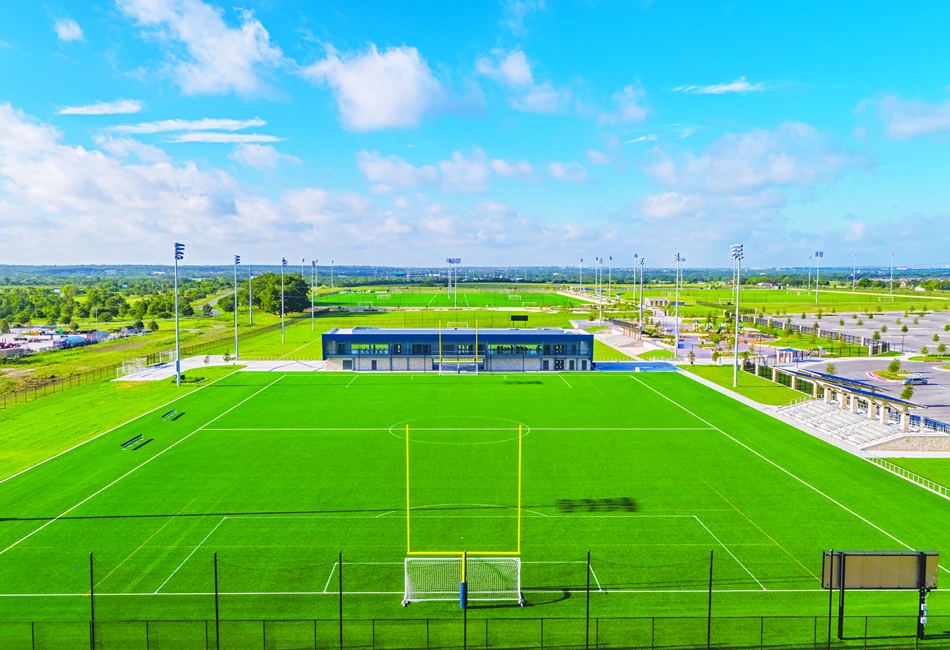
Parallel to the operator transition, a separate but deeply related phenomenon was reshaping the physical landscape of youth sports: the purpose-built mega-facility boom. Local governments, convinced, often correctly, that a world-class sports complex could anchor an entire tourism economy, began floating significant bond measures to build facilities that would have been unimaginable to the coach behind the folding table.
Fast forward to today. Sports Planning Guide tracked 162 new multi-sport facility developments in 2025, among them a $70 million Western Sports Park in Davis County, Utah; a 100-acre campus with 22 youth baseball and softball fields in New Lenox, Illinois; and proposed developments in Fort Worth targeting 2030 at an estimated $82 million. These aren’t municipal park upgrades that carried the industry for decades. Instead, the conversation now revolves around economic development strategies anchored in the demonstrated power of sports tourism.
The data behind those strategies is compelling. Youth and amateur sports generated $52.2 billion in direct travel-related spending nationally in 2023, outpacing spectator sports tourism’s $47.1 billion. Total economic impact, including indirect and induced spending, reached $128 billion, supporting 757,600 jobs and generating $20.1 billion in taxes. In 63 percent of the cities surveyed, sports events were the single largest room-night generator.
For young athletes, this facility boom has been genuinely positive. Today’s travel sports family arrives at LED-lit synthetic turf fields with covered dugouts, integrated concession operations and proximity to full-service hotels. The experience is categorically better than the auxiliary gym with no air conditioning that characterized the previous era. That improvement is real and should be acknowledged.
But the facility boom and the private equity wave are not separate stories. They are converging forces, and their intersection is where the most consequential questions for destinations and rights holders are now being raised.
The Industry at an Inflection Point
What the youth tournament sports industry is experiencing today is not disruption in the Silicon Valley sense of the word. It is industrialization: the same process that transformed craft production into manufacturing, regional banking into national chains and neighborhood veterinary clinics into corporate care networks. The fundamentals of the product have not changed. A weekend tournament is still a weekend tournament. What has changed is who controls the infrastructure around it and what they expect from the experience.
The CVB that built a decade-long relationship with an independent tournament director is now discovering that the company which acquired that operator has an entirely different set of expectations, objectives and procurement processes.
“The destination that invested taxpayer dollars in a public sports complex is now competing, sometimes directly, with privately owned facilities built by the same capital that is consolidating the operator side of the market.”
The family that pays thousands of dollars annually in travel sports fees today has no visibility into whether those fees reflect the cost of a passionate coach running an event or the return target of a private equity fund.
None of this is inherently sinister. Capital has brought genuine improvements to the industry—in operations, in facilities, in the consistency and quality of the athlete experience. But it has also fundamentally changed the rules of engagement for everyone in the ecosystem, and most of the industry is still playing by the old rules.
This series is about understanding the new rules. Over the next three installments, Sports Planning Guide will examine who is buying this industry and why, what the facility convergence means for public investment in sports tourism infrastructure, how destinations and rights holders can adapt their strategies for a more sophisticated counterpart across the negotiating table and where the entire ecosystem may be heading as family spending faces its own gravity.
The coach behind the folding table built something remarkable. Understanding what it is becoming, clearly, without nostalgia and without alarm, is the work of the industry now.
ABOUT THE AUTHOR
Jeff Gayduk is the founder and publisher of Sports Planning Guide and has covered the youth and amateur sports tourism industry for 15 years.
Ready to plan your next event? Join the planners who rely on Sports Planning Guide for destinations, facilities, and industry insight. Subscribe free here.