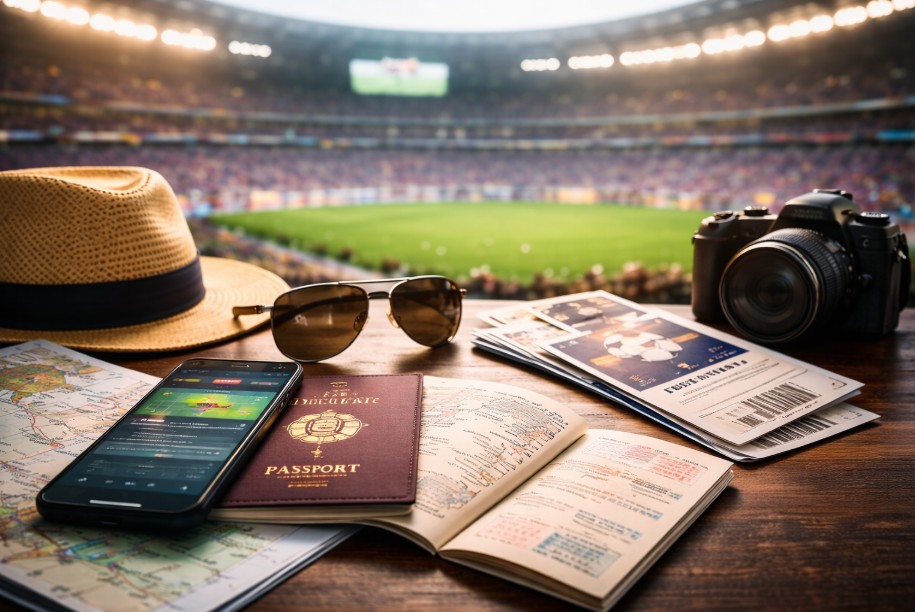
Some trips start with a fixture list, not a beach map. UEFA has already fixed the 2026 Champions League final for 30 May at the Puskás Aréna in Budapest, and that single date will shape flights, hotel prices, and three-day itineraries long before the finalists are known. People go. They go because a live match still gives them something a replay does not: the walk to the ground, the noise when the teams come out, and the small changes in a game that do not look the same on a laptop screen.
The calendar becomes the itinerary
Once a competition spreads across countries, the sport starts writing travel plans for people. The NFL scheduled seven international games across five countries in 2025, which are to take place in Dublin, London, Berlin, Madrid, and São Paulo, and one of the London dates at Wembley sent the Jacksonville Jaguars into their 14th game in the capital as part of the club’s long U.K. commitment. That sort of schedule does not just attract home fans already in the city. It pulls in supporters who build a week around one kickoff, then add a museum, a train ride, or another match before flying back on Monday.
The seat is only part of the purchase
Formula 1 has turned this into a full-scale travel habit. The sport said total attendance for the 2025 season reached 6.7 million, the highest combined figure on record, with 19 of 24 events sold out; Silverstone drew 500,000 over the weekend and Albert Park 465,000. Fans are buying more than a ticket when numbers get that large. They are buying a route, a hotel near the station, a pub that will stay open after qualifying, and the right to say they were there when the lights went out.
The game looks different on the ground
People still cross borders because the match gives up more details from inside the stadium. Chelsea’s 3-0 win over Barcelona on 26 November 2025 turned on a short-corner routine with Estevão, Alejandro Garnacho, and Marc Cucurella that created a three-versus-two before Jules Koundé put the ball into his own net; Paris beat Barcelona 2-1 on 2 October by sending runners behind a man-to-man press; Liverpool won 1-0 at Inter on 10 December with Ryan Gravenberch dropping deep and Arne Slot shifting the press after Inter’s substitutions on 11 and 31 minutes. Those are small observations, but they explain the ticket better than any slogan. A crowd feels a tactical swing before a broadcast panel names it.
The phone travels too
Travel days now come with a second screen and a battery pack. The NFL’s 2025 London ticket guidance made it clear that every fan at Tottenham Hotspur Stadium would need a digital ticket saved to a smartphone, with links delivered up to 48 hours before gameday. It shows how modern sports tourism now lives across multiple apps at once — from digital wallets and rail services to lineups pages and live tables. Some supporters also rely on matchday tools that track prices and in-game movement, so downloading platforms like Melbet (Arabic: تحميل melbet) becomes part of the same routine, alongside map pins, transport updates, and score alerts.
Big events turned fan trips into an industry
The scale is too large now to call this a niche. An independent study cited by the IOC projected between 2.3 million and 3.1 million unique visitors with Games tickets for Paris 2024, while FIFA said the 2025 Club World Cup group stage drew 1,667,819 spectators at an average of 34,746 per match. The biggest group-stage crowd was 80,619 for Paris Saint-Germain against Atlético de Madrid at the Rose Bowl in Los Angeles, and Real Madrid against Pachuca in Charlotte drew 70,248. Those are travel numbers as much as attendance numbers.
The road still matters
What people remember is rarely limited to the score. It is the station platform full of away shirts, the turnstiles opening an hour before kick-off, the first look at the pitch from the concourse, and the slow emptying of a city after the final whistle. Budapest will get that on 30 May 2026, just as London got it on NFL weekends and Silverstone got it across a sold-out race week. Sport keeps producing tourists because live games still organise time, money, and attention more cleanly than almost anything else on a calendar.