
The beautiful game is growing in the United States as organizers seek ways to maintain participation levels past pre-teen years
By Matt Swenson
Michael Lazar, senior vice president for strategy at U.S. Soccer, fell in love with the beautiful game in 1994, watching a World Cup match at Soldier Field in Chicago. It’s a common story for a generation of soccer fanatics who’ve seen the sport firmly implant itself into the American mainstream.
This summer’s sequel isn’t likely to have the same impact. How could it? Major League Soccer and the National Women’s Soccer League are direct outgrowths of FIFA, placing its grandest event in the land of opportunity. The U.S. Women’s National Soccer team has won three World Championships in that span, only adding to the fan and participation base.
Yet a World Cup boom is already underway amid a far different landscape. It’s considered a given within all levels of soccer organizations that participation will grow dramatically over the next year or two. In the 1990s, achieving an increased foothold in this country was the goal. This time around, U.S. Soccer, franchises, clubs, travel teams, and recreational entities are more focused on retention as soccer has a chance to take the next step in the country.
“We need to put the player at the center of all the decisions we make,” says Lazar.
The next soccer boom won’t wait for you to catch up. Find the venues ready to host your event before demand spikes.
Recreation vs Travel
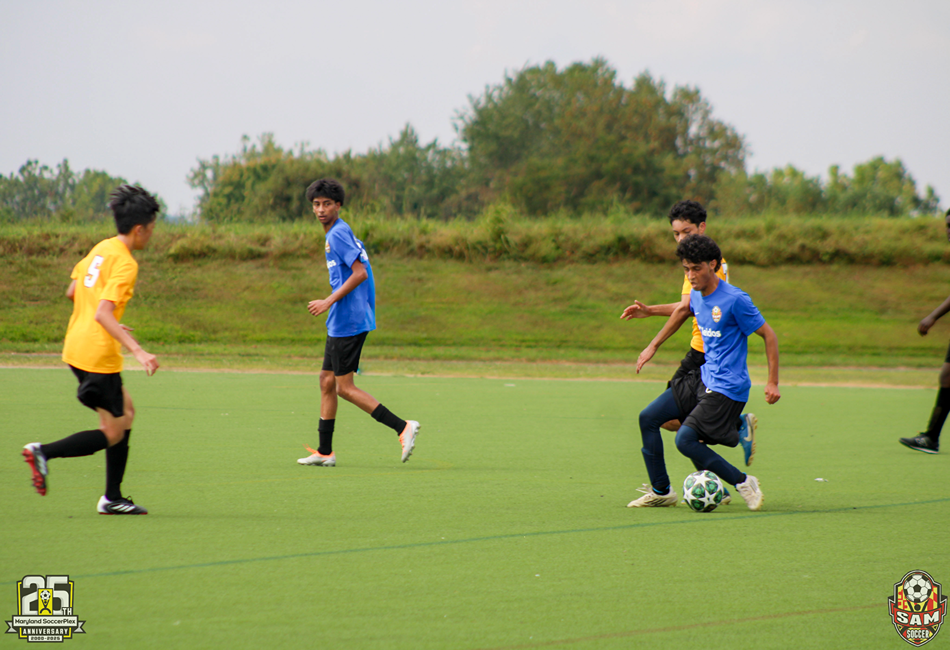
The number of Americans playing soccer is at an all-time high. In 2025, there were 16.7 million participants ages 6 and up playing outdoor soccer and 6.6 million active in indoor versions like futsal, according to the Sports and Fitness Industry Association. The statistics reveal a 2.2 million surge in the past year as the buildup for the World Cup has intensified.
Sustaining that momentum may require reconsidering the sport’s structural integrity across the U.S. There are thousands of soccer teams in the country with a variety of levels. For new players and parents, finding the right fit can be challenging.
“The ecosystem is fragmented,” Lazar acknowledges.
How that’s playing out is that too many young athletes are leaving recreation leagues to play travel soccer, says Matt Libber, executive director of the Maryland Soccer Plex in Montgomery County, Maryland.
A former event organizer, Libber has seen a shift from club teams attracting elite athletes primarily to accepting lesser-skilled players with little hope of earning a college scholarship, let alone becoming a professional. While travel sports offer a different and often positive experience, Libber says parents should “look at the math” before making the financial and time commitment.
“They’re basically paying to play rec soccer in another state,” Libber says. “If you are on the third or fourth level club team, you should be playing rec.”
John Guidroz, founder of Snap Soccer, a Southern-based tournament and events company serving 60,000 athletes at tournaments, says travel soccer’s success is the result of long-term infrastructure investment, strategic partnerships, and experience-focused event management. Snap’s tournaments sparked interest in parts of the country lagging behind the sport’s surge, he says. Guidroz prefers to avoid delineating between club and rec athletes and focus on encouraging participation.
“You really have 1,500 kids playing soccer in your community,” he says, as an example.
Where Is Youth Soccer Headed?
Parents paying thousands of dollars annually for their kids to play soccer helps fuel the country’s sports tourism industry, which Sports ETA reports generates $274.5 billion total economic impact, supports 1.6 million jobs, and produces $20.5 billion in state and local tax revenue nationwide.
For example, the Foley Sports Tourism Complex in Alabama, where Snap has held tournaments since the facility’s opening in 2016, hosted 85 events in 2025, drawing 253,177 visitors to the city. The city estimates earning $44.5 million in business sales and generating $2.5 million in local tax revenue from the sports tourism facility.
Don Staley, the complex’s initial executive director and former head soccer coach at Radford University and the University of Alabama, predicts that more than the 11 U.S. destinations hosting World Cup matches will benefit from the summer megaevent.
“There will be more tournaments created because of this boom,” says Staley, who is now president and CEO of Southeastern Network of Athletic Professionals, a sports tourism consulting firm.
U.S. Soccer and US Club Soccer have reservations about the accelerated growth of travel soccer. The increased interest in the sport presents opportunities for right-sized development so that players can have the best experience possible and stick with the sport longer, says Tyler Heffernan, vice president of marketing and communications at US Club Soccer.
Both national governing bodies are pushing to reduce the number of travel tournaments for young athletes. The high costs create economic disparities in a sport that traditionally requires a ball, a field, and two goals to play.
“Far too often, teams travel past good, neighboring opponents because those teams are affiliated with different organizations or leagues,” Heffernan says.
Burnout is another concern, with 10–13-year-olds, particularly girls, among the most likely to quit soccer for another activity, says Lazar. Libber notes that recreation leagues in Maryland have adopted a 7v7 format instead of a standard 11v11 for U14 soccer to compensate for the low numbers.
National 1 League is how U.S. Soccer and US Club Soccer aim to address the concerns. Beginning next season, US Club Soccer’s National Premier Leagues and the USYS National League will consolidate competitions and create a uniform experience while minimizing school and family disruptions.
Other factors requiring attention are recruiting top-level coaches and referees and finding more playing space, adds Heffernan. As part of its outreach. U.S. Soccer is working with a community in North Texas to manage a facility, according to Lazar.
“Putting fun back into a lot of what we do is really important,” he says of the management philosophy.
Guidroz says small adjustments like starting games at 8:30 AM instead of 8 AM are how organizers can demonstrate they place families’ experience over recruiting as many teams as possible to a tournament.
“We truly owe our time and our respect to the people who are coming to participate in our events,” Guidroz says. Heffernan notes that scrutiny over costs and commitment should keep planners on guard to provide the best product possible.
“That doesn’t mean travel to tournaments and events is going away, far from it. But it does mean that tournament organizers need to prove their value,” Heffernan says.
Ready to capitalize on the soccer surge? Browse venues and destinations built for the game and put your event on the map.