How Smart Destinations Are Taking the Guesswork Out of Sports Facility Development
In a national facility arms race, “what we want to build” is no longer a strategy. A public strategic-planning session in Champaign County, Illinois offers a window into how data-driven destinations are aligning community benefit with sports tourism revenue before a single shovel hits the ground.
By Jeff Gayduk
AN ARMS RACE WITH PUBLIC MONEY
The numbers coming out of the sports tourism industry no longer need embellishment. Sports ETA’s 2025 State of the Industry report pegs the sector at $274.5 billion in total economic impact, built on $111.2 billion in direct spending, 1.6 million jobs and more than 124 million room nights. Buried in that report is the statistic that should reframe every facility conversation in America: participatory sports tourism — the youth and amateur events that fill mid-market hotels on tournament weekends — now outproduces spectator sports, generating $60.1 billion in direct spending from 227.6 million travelers.
Capital has noticed. Sports Planning Guide has tracked 275 new facility builds or substantial upgrades since 2025. L.E.K. Consulting counts more than $2.5 billion invested in new or upgraded youth sports complexes between 2024 and 2026. Broader industry tallies put the figure north of $9 billion since 2017. The Aspen Institute’s Project Play now lists the facility “arms race” among the defining trends in youth sports, and the map backs it up, from the $80 million regional sports center that just opened its doors in Williamsburg, Virginia, to the $140 million complex rising in Odessa, Texas.
But arms races produce casualties, and in this one the casualty rate is quantifiable. Industry analyses suggest a youth sports complex needs 70 to 80 percent utilization, year-round, just to stay solvent. The Sports Facilities Companies, which has conducted feasibility work for hundreds of municipalities, reports that roughly 30 percent of its studies conclude the project as the client defined it initially is not feasible, and another 40 percent come back “yes, if,” meaning the concept only works with substantive changes. Read that again: roughly seven in ten facility concepts don’t pencil as originally drawn.
That is the environment in which every CVB, sports commission, park district and city council now operates. The decision matrix can no longer start with what a destination wants to build. It has to start with what the market will support, what the community will actually use. To be successful, those two answers must overlap.
Which is why a strategic planning session this summer in Champaign County, Illinois is worth a closer look.
PUTTING THE OWNERSHIP CHIPS ON THE TABLE
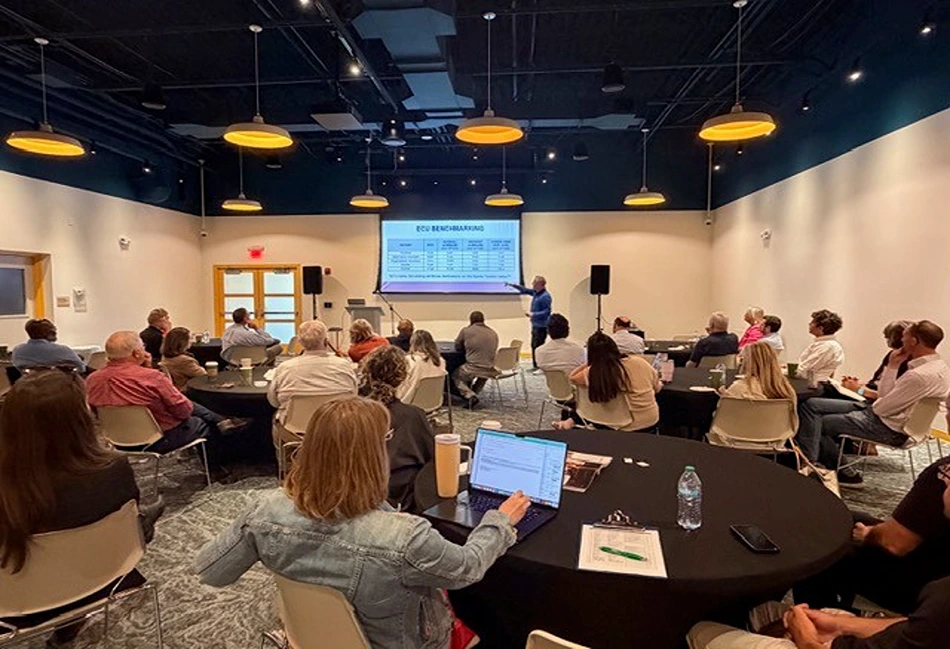
In late June 2026, Experience Champaign-Urbana convened the county’s sports stakeholders including local government officials, park districts, University of Illinois representatives, and hoteliers for the public rollout of a countywide sports tourism strategic plan produced by Huddle Up Group, the Phoenix-based consultancy founded by Jon Schmieder. Huddle Up has produced more than 120 of these plans over 15 years; before that, Schmieder spent 16 years in the CEO chair of sports commissions in Tulsa, Denver and Phoenix. “We used to say, ‘this is what I would do if I was in your seat,’” he told the room. Now the firm leads with data and layers experience on top.
What Champaign-Urbana bought was not a poster board rendering. It was four months of stakeholder interviews, venue tours and community surveys anchored by two proprietary datasets and a public accounting of where the destination actually stands.
The centerpiece is the Sports Tourism Index, a benchmarking platform Huddle Up has run 473 destinations through, representing roughly 80 percent of the active sports destination market. The Index scores a community across four areas: facilities, destination strength, organization and events. Champaign-Urbana scored 47.6 — comfortably above the 37.96 national average and the 38.81 Midwest average, though well shy of the 76 posted by the highest-scoring destination Huddle Up has ever measured. The gap is the point: above average is not the same as competitive, and the Index shows a community exactly which levers it can still pull. Destination strength includes a marathon with decades of history and an iconic Big Ten university. The other three areas respond directly to investment. Put money into human capital and facilities, Schmieder explained, and event counts follow; economic impact and hotel revenue follow those.
The findings themselves were a study in candor. Strengths: an unusual history of stakeholder collaboration, legacy events to build from, and geography that makes the market easy to reach. Challenges: quality venues the CVB cannot reliably book because they’re controlled by the university and schools (event owners need dates two years out and they can’t get them) a climate that demands indoor inventory, and hotel pricing practices during peak University events, including rate spikes and multi-night minimum stays, that surfaced repeatedly in stakeholder interviews as a threat to future business.
But what distinguished the session wasn’t the SWOT analysis. It was the posture. Schmieder’s first recommendation was not a building, it was a standing sports advisory council where, as he put it, every entity puts its ownership chips in the middle of the table: each park district, village and institution disclosing its facility aspirations before anyone commits capital, so the region doesn’t duplicate itself into failure.
Underneath that recommendation is a political calculation Huddle Up has watched play out nationally. “Generally speaking, if the tourism entity goes by itself, it can’t get the political will to build something,” Schmieder told the group. Park districts fare no better alone — most carry 20-year master plans with no funding attached. “Where we can lock the two together — tourism on the weekends, community use during the week — those destinations get to the finish line together.”
“If the tourism entity goes by itself, it can’t get the political will to build something. Where we can lock the two together, those destinations get to the finish line together.”
Jon Schmieder, Huddle Up Group
READING THE MARKET BEFORE YOU POUR CONCRETE
So what does “data-driven” actually look like when the question is a $30–40 million building? At the Champaign-Urbana session, it looked like ESRI participation data run through two distinct lenses: a 60-minute drive-time market, which answers whether local residents will fill the building Monday through Thursday, and a 300-minute market, which answers whether teams will travel and stay overnight. Both have to clear. A facility that only works as a tournament venue sits dark all week; one that only serves locals never generates a room night.
The indexing gets granular. Against a national baseline of 100, Champaign-Urbana’s volleyball participation indexes at 123 within an hour’s drive meaning residents are 23 percent more likely to play than the national average. That number does double duty: it signals strong local clubs that will program weekday hours, and it hands the CVB a sales story to take to national event owners. Similar data ranks which sports book furthest in advance. Cheer and dance competitions, by Huddle Up’s numbers, lock in hotel blocks roughly 184 days out, making them among the most planner-friendly business a destination can chase.
The data also dictates what kind of building. Huddle Up’s periodic surveys of event owners sort demand into two buckets: “anchor” facilities — everything under one roof, one parking lot, one entrance — and “tournament-friendly” multi-site inventory suited to local and regional play. National championships overwhelmingly want anchors. It’s a distinction that exposed a hidden weakness in Champaign-Urbana’s stock: the market technically has plenty of courts, but split between buildings and wings, they don’t function as the single-site product event owners are buying.
Then there’s the economic modeling, where Huddle Up’s conservatism is itself instructive. The firm doesn’t project hoped-for business. It programs a hypothetical operating year using only known, verifiable events from its database of roughly 1,500, assumes the destination captures about a quarter of them, and counts spectators at a one-to-one ratio with athletes unless an event owner can document turnstile counts. This holds true even for female-focused sports where the real ratio runs far higher. On average 3.1 family members travel to an out-of-town girl’s sporting event, with boys that number drops to .9.
Two more principles round out the discipline. The first is land. “Any developer will tell you: if they have to retire the debt on the building and on the land, the P&L just goes upside down,” Schmieder says. The projects that work start with municipally controlled sites. Places like Grand Chute, Wisconsin, which leased the ground under Appleton’s Champion Center to the tourism bureau for a dollar a year for 30 years, now collects sales tax on every transaction inside the building.
The second is independence. Huddle Up’s Champaign-Urbana recommendations pointedly stopped short of a bricks-and-mortar verdict: the firm called for independent, third-party feasibility studies on both the hardcourt concept and the community’s long-debated ice question. “We’re not allowed to write our own paper,” Schmieder told the room. It’s a standard more consultants and more communities should adopt.
“Any developer will tell you: if they have to retire the debt on the building and the land, the P&L just goes upside down.”
Jon Schmieder, Huddle Up Group
THE RIBBON-CUTTING IS THE EASY PART
The strategist’s discipline gets a second from the operator’s chair. Ashley Whittaker, partner and chief marketing officer of The Sports Facilities Companies whose SFC Network manages more than 100 venues nationwide told SPG earlier this year that communities routinely get seduced by the ribbon-cutting feel-goods while underweighting the 30-year operating question. Her framework maps almost perfectly onto Huddle Up’s: build to what the market data says your region needs, not to a sport type someone loves; know your subsidy number, things like turf replacement, operating costs and debt service from day one; and understand that operator quality is the variable that makes physically identical buildings perform completely differently. Most sobering of all: in SFC’s experience, projects die from political misalignment more often than from bad financials.
When the alignment holds, the ceiling is remarkable. Hoover Metropolitan Complex in Hoover, Alabama (an SFC-managed venue) drew a record 785,000 visitors in fiscal 2025, generated $101 million in total economic impact and more than 92,000 hotel room nights, and posted a $1.3 million operating profit, extending a run of positive margins that is genuinely unusual for a city-funded sports venue. The surrounding district has since attracted apartments, retail and an entertainment corridor. This is private investment catalyzed by the facility’s traffic. None of that was luck, it was market fit, programming strategy and operational discipline settled before ground broke.
Read our full conversation with Sports ETA’s 2024 Woman of the Year
THREE COUNTIES, THREE POOLS — OR ONE AUTHORITY, ONE BUILDING
The alternative has a case study too. Schmieder points to a stretch of Florida’s Atlantic coast where three neighboring counties, without coordinating, each built their own aquatic facility within a few years of one another. One of them should have built the pool. Another should have built the fieldhouse. Instead, three communities now compete for the same swim meets with three versions of the same asset and their shared sports commission is left navigating the crossfire among its own stakeholders.
Contrast that with what opened this summer in Virginia. The City of Williamsburg, James City County and York County had pursued a regional indoor sports center since 2014. Rather than three competing projects, the localities formed a joint regional authority to build one: the $80 million, 200,000-square-foot Greater Williamsburg Sports & Events Center, with hardcourt space for 12 basketball courts converting to 24 volleyball or 36 pickleball courts and the largest conversion turf system in the country. Construction is funded by tourism-related taxes, including a one percent regional sales tax dedicated by state law to tourism projects — not property taxes. KemperSports operates the building. And the dual mandate isn’t a talking point; it’s written into the operating calendar: local recreation programs Monday through Thursday, regional and national tournaments on the weekends.
See inside the $80 million Greater Williamsburg Sports & Events Center — from its 12-court main hall to the largest retractable turf system in the country.
The Williamsburg example landed hard in the Champaign County room — a history-first destination deliberately reinventing itself as a sports destination, financed regionally because every participating community shares the benefit. “When you think of Williamsburg, do you think of sports? No — you think of history,” Jane DeLuce, president and CEO of Experience Champaign-Urbana observed on a local visit. “They’re reinventing themselves as a sports destination.” DeLuce supplied the discipline that keeps the aspiration honest: “We want this to be for the community, but we also have to look at what’s going to bring in the outside people to help pay for it.”
And the community side of that ledger is not an abstraction. When Grand Chute built the Champion Center, the area’s figure skating programs had 300 girls on a waitlist because they couldn’t get ice time. The new building took the pressure off existing sheets; those skaters now run their own programs on ice they never had access to before. “Yes, our kids get a better place to play too” isn’t a throwaway line in these projects. Done right, it’s the political foundation that gets them built.
“When you think of Williamsburg, do you think of sports? No – you think of history. They’re reinventing themselves.”
Jayne Deluce, Experience Champaign-Urbana
DECIDE WITH DATA — OR HAVE IT DECIDED FOR YOU
The capital is not waiting for anyone’s consensus. Private equity-backed consolidators are rolling up clubs, tournament operators and facilities at a pace the industry has never seen. They underwrite every deal with participation data, drive-time analysis and utilization models. A municipality that brings civic aspiration to a spreadsheet fight will lose.
The destinations getting this right share a process, not a building type. They put every stakeholder’s ambitions on the table before anyone commits capital. They let independent data including participation indexes, event-owner demand, conservative pro formas — arbitrate among competing visions. They lock community use into the operating model rather than the press release. And they retain the discipline to hear “not feasible” and change course, knowing that seven in ten concepts need to.
In the race to build, the winners won’t be the communities that wanted it most. They’ll be the ones that asked the hardest questions first.
| SEVEN QUESTIONS EVERY DESTINATION SHOULD ASK BEFORE BREAKING GROUND |
| 1. What does the participation data say? Test demand two ways: a 60-minute drive market for weekday community use, and a 300-minute drive market for overnight tournament draw. If either fails, the concept changes. |
| 2. Who controls the calendar? A great venue you can’t book 18–24 months out is not sports tourism inventory. Access beats square footage. |
| 3. Anchor or tournament-friendly? National event owners want one roof, one parking lot, one schedule. Courts scattered across a campus check a box on paper and lose the bid in practice. |
| 4. What’s the subsidy number? Turf replacement cycles, operating costs and debt service belong in the conversation on day one, not after the ribbon-cutting. |
| 5. Who controls the land? If the project must retire debt on the building and a land purchase, the P&L goes upside down. Municipally controlled sites change the math. |
| 6. Is community use structural — or a promise? Lock local access into the operating calendar, the way Williamsburg reserved weekdays for residents and weekends for tournaments. A press release is not a pro forma. |
| 7. Who wrote the study? Nobody gets to write their own paper. Independent feasibility work is what lets every stakeholder say yes to the same set of facts. |