Swimming continues to dominate as a prominent sport at multiple levels—competitive, recreational, and everything in between. For rights-holders, coaches, and tournament directors, the most reliable venues are the ones that can support both athlete performance and spectator flow without creating bottlenecks on deck.
Premier swimming venues in the U.S. typically stand out for flexible pool configurations (bulkheads), strong meet operations (timing/scoreboards), warm-up capacity, and spectator amenities—plus easy access to lodging, parking, and airports for traveling teams.
Before you shortlist sites, confirm a few planning essentials:
Location basics: hotel inventory nearby, bus access/loading, and drive-time reliability
Pool configuration: course options (50m/25y), lane count, bulkheads, and warm-up space
Meet operations: electronic timing, scoreboard/video, marshal areas, team seating, and check-in flow
Spectator experience: seating capacity, sightlines, concessions, and climate control
Athlete support: locker rooms, training/dryland areas, and accessibility
FMC Natatorium at Ty Warner Park — Westmont, Illinois
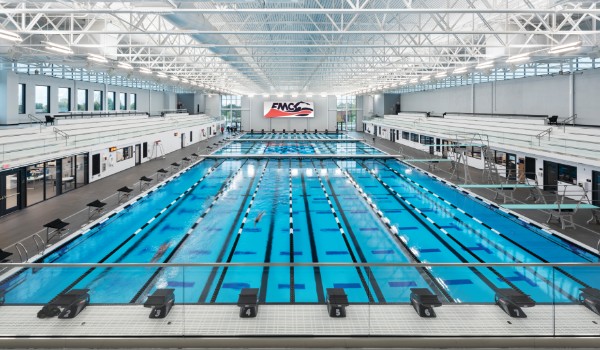
The FMC Natatorium is a state-of-the-art aquatic facility located at Ty Warner Park in DuPage County. Built for regional and national events, the natatorium features a 50-meter Myrtha competition pool and a 25-yard training pool. Spectator seating is on three sides with a capacity of up to 1,200, and the second floor includes a strength and conditioning room, swim shop, party/entertainment space, and concessions. (FMC Natatorium, n.d.)
Planner snapshot
Seating: up to 1,200 on three sides
Competition: 50m Myrtha pool; configurable with bulkheads
Training/warm-up: separate 25y training pool
Greensboro Aquatic Center — Greensboro, North Carolina
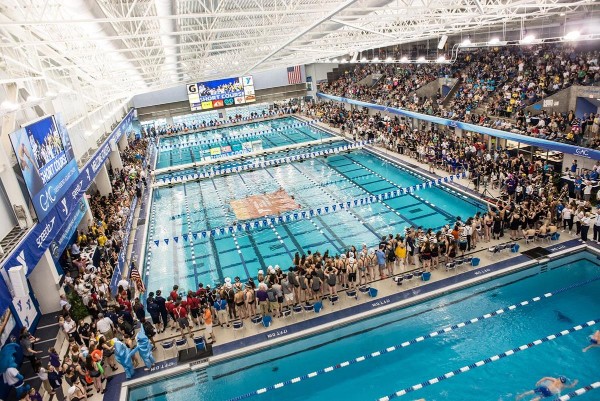
First opened in 2011, the Greensboro Aquatic Center (GAC) is acclaimed for transforming Greensboro into a swimming hot spot. Located on the campus of the Greensboro Coliseum Complex, GAC features a competition pool, warm-up/training water, and a diving well. Seating capacity is set at 2,500, and outside of major events the facility is open to the public with programming across age groups. (Greensboro Aquatic Center, n.d.)
Planner snapshot
Built for events + community programming
Spectator seating: 2,500
Liberty Natatorium — Lynchburg, Virginia
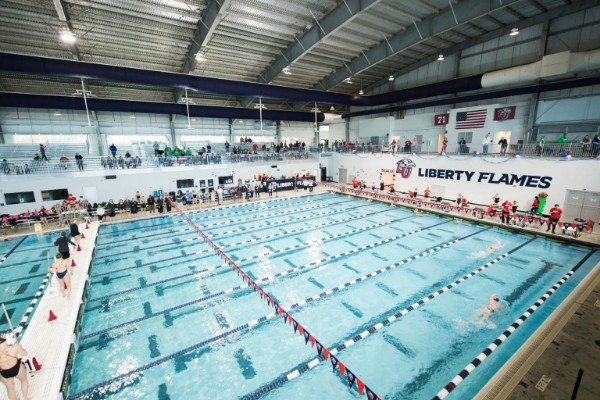
The Liberty Natatorium in Lynchburg has become a prime host for collegiate and competitive swimming. Opened in 2018, Liberty features a nine-lane, 50-meter pool with a moveable bulkhead. The facility is also paired with athlete support spaces, including training areas and recovery resources. (Liberty University Athletics, n.d.)
Planner snapshot
Designed with meet production in mind (broadcast-ready)
Pool: 50m, nine lanes; moveable bulkhead
The National Training Center — Clermont, Florida
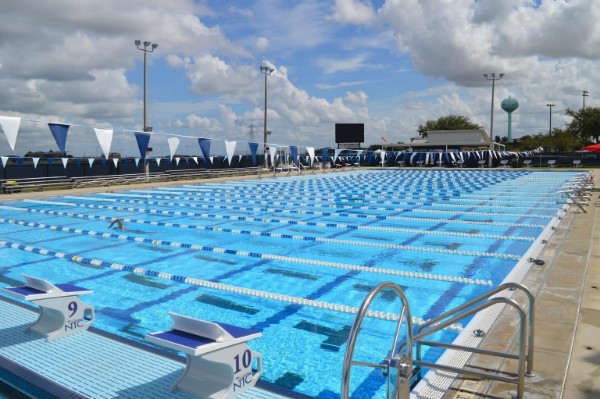
Lake County’s Aquatic Center at the National Training Center (NTC) is built for team training and competition. The Aquatic Center features a 70-meter x 25-yard pool with 27 lanes at 25 yards, plus a moveable bulkhead for configuration flexibility. It’s an outdoor heated venue that supports year-round training and events. (National Training Center, n.d.)
Planner snapshot
Meet flexibility: moveable bulkhead
Pool: 70m x 25y; 27 x 25-yard lanes
Razorback Natatorium — Fayetteville, Arkansas
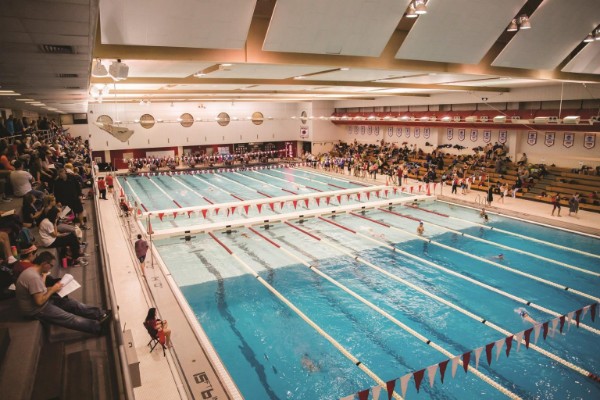
Razorback Natatorium in Arkansas is a major collegiate venue and a consistent training site for high-level athletes. The natatorium is an indoor, eight-lane, 50-meter pool with a complete timing system and scoreboard, and it includes diving infrastructure (boards and platforms). Venue capacity is listed at 1,500. (Arkansas Razorbacks, n.d.)
Planner snapshot
Diving support: multiple boards + platforms
Pool: indoor 50m, eight lanes
Capacity: 1,500
Texas A&M Natatorium — College Station, Texas
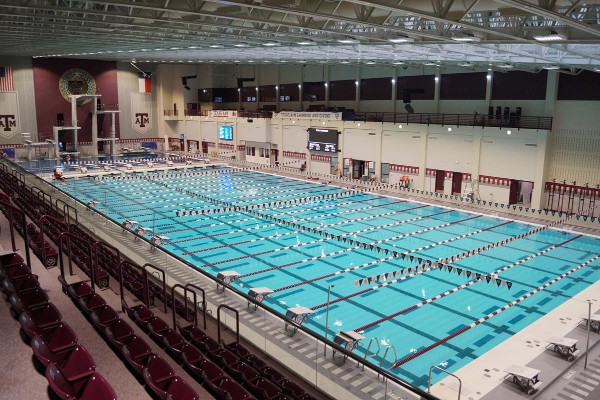
The Texas A&M Natatorium is a championship-caliber site for major swimming and diving events. The facility includes a 50-meter, eight-lane competition pool with two moveable bulkheads, underwater viewing windows, and an electronic timing system. Permanent on-deck spectator seating is listed at 1,100 (with additional capacity available), and the diving well includes multiple platform heights. (Texas A&M Athletics, n.d.; Visit College Station, n.d.)
Planner snapshot
Diving well: platforms up to 10m
Seating: 1,100 permanent (plus additional capacity)
Pool: 50m eight-lane; two moveable bulkheads
Wall Aquatic Center — Flagstaff, Arizona
Located on Northern Arizona University’s campus in Flagstaff, the Wall Aquatic Center is a standout high-altitude training and event option. The venue features an Olympic-size pool with configuration flexibility (moveable bulkhead) and is positioned at roughly 7,000 feet—a meaningful differentiator for teams planning altitude blocks. (Northern Arizona University, n.d.)
Planner snapshot
- Altitude: ~7,000 ft
- Pool: Olympic-size with moveable bulkhead
- Seating: event-capable spectator setup (see venue details when booking)
If you’re comparing options for a championship meet, a multi-session invitational, or a travel-heavy youth event, start with pool/warm-up capacity and meet-ops flow—then let geography (air access + hotel concentration) break the tie.
By Christopher D. Silbernagel
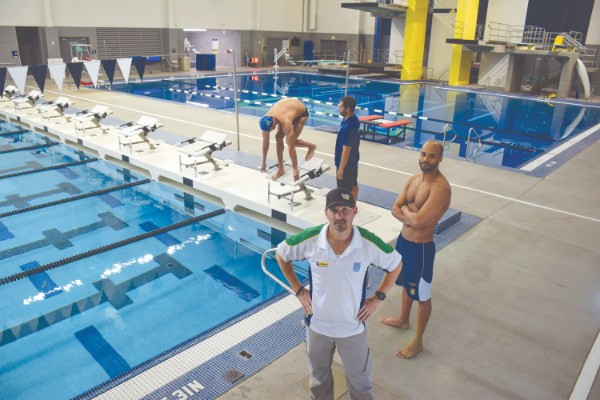
Main image: The competition is hot at Texas A&M Natatorium.
FAQ
Q1: What pool setup is best for a large invitational (multi-session) meet?
Look for a venue with bulkheads and a dedicated warm-up pool so you can run competition and warm-up simultaneously. Prioritize clear athlete flow and deck space for marshaling.
Q2: How much spectator seating is “enough” for a championship weekend?
It depends on session format and team travel size, but venues in the 1,000–2,500 range handle peak finals sessions more comfortably. Also check sightlines and concourse space—capacity alone doesn’t prevent crowding.
Q3: What should a rights-holder ask about meet operations before signing?
Confirm timing system compatibility, scoreboard/video support, wifi reliability (if needed), and where teams line up and stage. Ask who provides key staffing roles (deck marshals, officials rooms, security, lifeguards).
Q4: Are these venues available for rentals outside of varsity competitions?
Many are. Availability often depends on seasonality, campus priority windows, and local programming schedules—so you’ll want written confirmation of lanes/warm-up blocks by session.
Q5: What’s the most common “hidden constraint” for indoor swim events?
Warm-up capacity and deck congestion. Even elite pools can struggle if warm-up is undersized or if team seating and spectator flow aren’t separated cleanly.