
Destinations across the globe continue investing in sports infrastructure designed to drive recreation, events and economic impact
Stay ahead of the game and discover cutting-edge innovations in the latest sports facility news.
Construction kicking off on Kraken Iceplex in Kirkland, Washington
The Seattle Kraken are expanding their investment in community sports with plans for the $60 million Kraken Iceplex Kirkland, a new two-rink facility and community center scheduled to break ground this spring and open in fall 2027. Located on the former Houghton Park & Ride site, the project is designed to meet growing demand for ice sports while creating a year-round destination for recreation, events and community engagement.
The development will feature two NHL-regulation ice rinks, a city-operated community center, restaurant, team store and flexible programming space. Leaders say the facility will support a wide range of activities, including youth and adult hockey leagues, learn-to-skate programs, figure skating, tournaments, public skating sessions and educational opportunities tied to STEM learning and career exploration.
Officials view the Iceplex as both a recreation asset and an economic development catalyst. In addition to expanding access to ice time and community programming, the project is expected to generate new visitor spending, support local businesses and contribute to the long-term growth of Kirkland’s evolving NE 85th Street district.
Austin, Texas, sports complex begins $25M overhaul
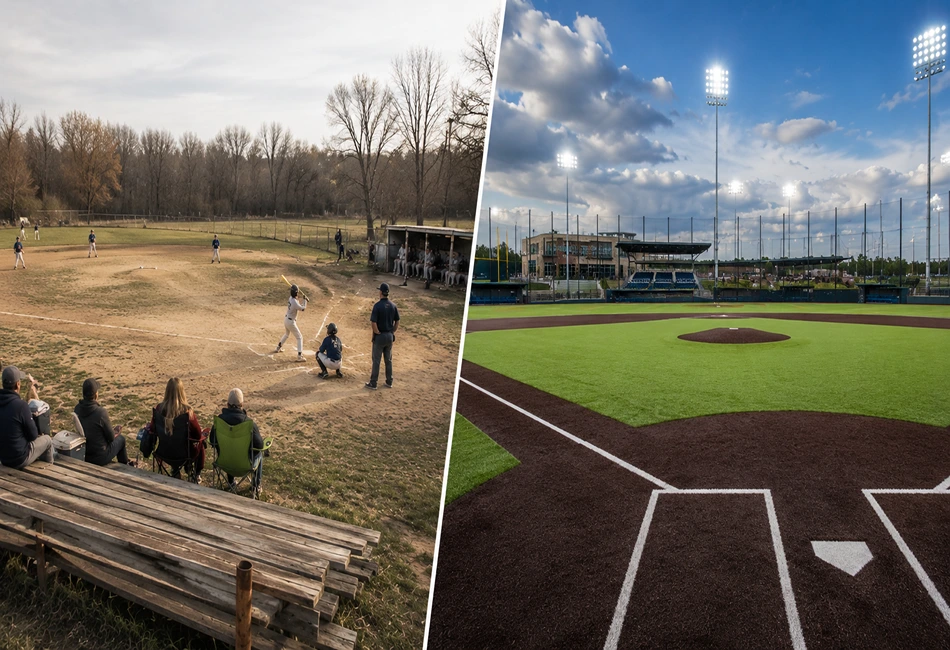
Austin Independent School District (ISD) is investing in significant upgrades at Nelson Field, one of the city’s busiest multi-sport venues, as part of a broader effort to enhance athletic opportunities for local student-athletes. A $6.8 million renovation project will focus on the baseball complex, including new turf, batting cages, dugout improvements and upgraded lighting. Construction is expected to begin this summer and conclude in early 2027.
The improvements are designed to create a safer, more functional environment for athletes from several Austin-area high schools that call Nelson Field home. Coaches say modernized facilities can improve the student experience, strengthen community pride and help programs remain competitive with neighboring districts when recruiting and retaining young athletes.
The baseball upgrades represent one phase of a larger $25 million investment planned for the overall complex. Future enhancements are expected to include renovations to the grandstands, field house, press box, concessions and restrooms. District leaders view the project as a long-term commitment to improving sports infrastructure while creating a more welcoming destination for athletes, families and fans.
Bertram sports complex expansion takes shape in Monticello, Minnesota
Monticello is advancing plans to transform Bertram Chain of Lakes Regional Athletic Park into a premier regional sports destination, following approval of an updated master plan that builds on years of community input and recreation planning. The long-range vision includes 17 athletic fields, expanded trails, nearly 1,000 parking spaces, additional pickleball courts and infrastructure designed to support both local play and tournament activity.
City leaders are accelerating the project timeline, with major construction targeted for 2027 and 2028 and much of the complex expected to be operational by spring 2029. Upcoming work will focus on critical infrastructure, including utilities, roads, stormwater systems, parking, trail connections and future field lighting. A Phase 3 project scheduled for this summer will add pickleball courts, parking and a maintenance facility.
The revised plan also reflects evolving recreation trends, replacing planned tennis courts with dedicated pickleball facilities and reserving space for a potential indoor sports complex. While not yet funded, the indoor component addresses growing demand for year-round recreation and could further strengthen Monticello’s ability to attract regional tournaments and visitor spending.
Bond proposal for Caddo Parish, Louisiana, athletic sports complex
Upgrade your planning process by exploring fresh insights and best practices with SPG InSite.
Plans revealed for London Colosseum basketball arena in England
Plans have been unveiled for the proposed London Colosseum, a 25,000-seat arena and mixed-use development that could become the largest indoor venue in the United Kingdom. Located in Stratford’s Olympic Park, the project is being advanced by Jericho Estates, Peacock Gym, Torch Sports and architects Chybik + Kristof. Designed with a flexible bowl configuration, the arena could host basketball, boxing, esports and other major events with capacities ranging from 18,000 to 25,000 spectators.
Project leaders say the venue is intended to be far more than an event space. The development would include training facilities, educational programming, public gathering areas, hospitality offerings, residential components and community-focused amenities. A multifunctional tower featuring hotel rooms, residences and community spaces is also planned, creating year-round activity beyond game and event days.
The proposal arrives as the NBA explores launching a European league as early as 2027 or 2028, with London viewed as a potential flagship market. Developers envision the arena serving as a future NBA Europe home while also attracting world championship boxing and global esports competitions. Sustainability goals include low-carbon construction methods, timber use, renewable energy technologies and design elements guided by circular economy principles.
O’Fallon, Illinois, leaders explore $20M-plus indoor fieldhouse to expand sports tourism
O’Fallon officials are exploring the development of a year-round indoor fieldhouse as the next step in expanding the city’s successful sports tourism strategy. The effort follows a feasibility study and builds on the momentum of Family Sports Park, which generated an estimated $9.6 million in visitor spending last year through tournaments and league play. City leaders say the proposed facility could strengthen O’Fallon’s position as a regional sports destination while serving the community year-round.
Preliminary plans call for a roughly 106,000-square-foot complex featuring eight basketball courts convertible to 16 volleyball courts, along with pickleball, indoor turf training space, meeting rooms and potential fitness amenities. Officials are also evaluating options for performance training areas, community programming and event rentals that would maximize both usage and revenue generation.
Estimated to cost more than $20 million, the project remains in the planning stages as city leaders evaluate locations, traffic impacts and funding options. Supporters believe the facility could expand tournament opportunities, reduce dependence on school gyms and meet growing demand for recreation programming that currently exceeds available space.
West Tampa, Florida, stadium vision moves forward with public-private partnership
The Tampa City Council and Hillsborough County Commission approved non-binding memorandums of understanding to advance negotiations on a proposed $2.3 billion stadium and mixed-use development for the Tampa Bay Rays. The proposed project would be located on the Hillsborough Community College campus in West Tampa and feature a new ballpark surrounded by retail, dining, hotel and office development.
The framework calls for a public-private funding partnership that includes nearly $1 billion in public investment, with contributions from Hillsborough County, the City of Tampa and the city’s Community Redevelopment Agency. While supporters view the project as a transformational economic opportunity, public meetings drew significant debate, with critics questioning the use of tax revenues and the long-term return on investment.
Project leaders emphasized that the agreements are non-binding and that substantial negotiations remain before a final deal is reached. In addition to a new stadium, plans include a reimagined college campus and workforce development opportunities. The Rays say the vision extends beyond baseball, creating a destination district designed to generate economic activity and support regional growth for decades to come.
SPG Take
This Breaking Ground highlights two very different approaches to sports facility development. In Kirkland, Austin, Monticello and O’Fallon, investments are centered on facilities designed to expand access, serve residents and strengthen youth and community recreation systems.
The proposed stadium development in Tampa introduces a different dynamic. Unlike community-oriented facilities, professional sports venues are often structured around privately owned franchises and adjacent entertainment districts yet frequently depend on significant public funding. Supporters cite economic development, destination appeal, long-term growth, etc., though a wide body of research shows these outcomes are difficult to predict and often more complex than initial projections suggest.
As destinations continue to evaluate sports-driven development, the central question shifts from whether these projects generate value to how that value is distributed, and who ultimately benefits. When public dollars are part of the equation, communities are increasingly weighing whether returns are greater when invested in broad-based participation and access, or in facilities designed primarily to support professional franchises and adjacent commercial activity.
Some ownership groups are responding by taking a different approach. For example: the Chicago Fire have pursued a fully privately financed stadium in a centrally located riverfront setting, reflecting a model where development costs and long-term upside remain largely within the ownership structure rather than the public sector.
This growing divergence in financing approaches may shape the next generation of sports infrastructure decisions as much as any feasibility study or economic impact projection.
Sports Planning Guide