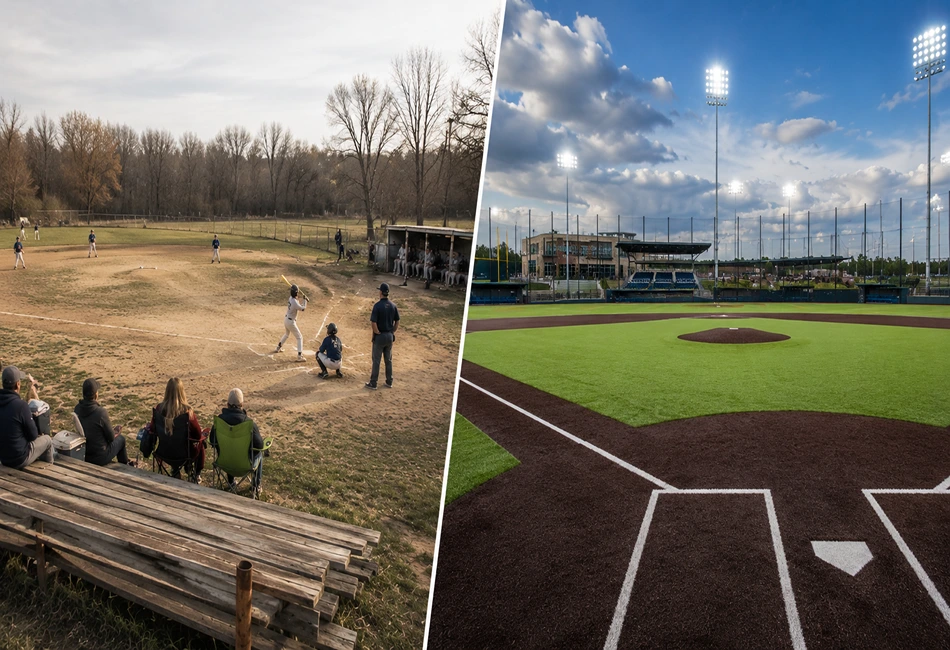
From cheerleading mats to baseball diamonds, institutional capital is buying the infrastructure of youth athletics. The deals are accelerating and Congress is watching. The industry will never look the same.
By Jeff Gayduk
Private equity didn’t stumble into youth sports. It arrived with a thesis, a playbook, and enough capital to reshape an industry built on coaching credentials and personal cell phone numbers. The result is that the rules of this business are changing faster than most players in the sports tourism industry realize.
Why This Market, Why Now?
Numbers have a way of explaining things that an argument cannot. Private equity investments in amateur sports reached $2.11 billion in just the first five months of 2026, already more than four times the $550 million recorded for all of 2025, according to S&P Global Market Intelligence.
The thesis here is straightforward: youth sports is a $40 billion annual market in the United States, growing at eight to ten percent per year, with no single company controlling a meaningful share of the total. It survived the most severe economic disruption in modern memory and came back stronger. According to Sports ETA, in 63 percent of U.S. cities, sports events are the single largest market for hotel room-nights generated.
When a market that size is fragmented, growing, recession-resistant, and full of owner-operators approaching exit age with no institutional buyers in sight, private equity does not need an invite.
Three Ways to Own This Industry
The firms entering youth sports are not all running the same playbook. Three distinct investment strategies are operating simultaneously, and understanding the difference is critical for anyone doing business in this space.
The first is the platform play: build a company large enough to dominate the operational infrastructure of youth sports, capturing revenue across uniforms, equipment, competitions and media. The second is the experiential play: own the destination brands and facilities that families will travel. The third is the infrastructure play: own the technology layer that every operator, league, and club depends on to run its business, regardless of who is putting on the events.
All three are well underway, and in 2026, they are converging.
KKR: the Platform Play
No firm has moved more aggressively into youth sports than KKR. Its $4.75 billion acquisition of Varsity Brands in 2024 remains the largest single transaction in the sector’s history. The company it acquired is not a tournament operator in a traditional sense. Varsity Brands is the connective tissue of youth athletics: BSN Sports is the country’s largest team dealer with 1,500 salespeople and relationships with 700 vendors including Nike, Adidas, and Under Armour. Varsity Spirit runs 600 regional, state and national cheerleading championships annually while training 350,000 athletes through its camps. With combined revenue that exceeds $3 billion, the platform serves more than 8 million athletes.
KKR also owns PlayOn! Sports (acquired in 2022), which operates the country’s largest high school sports media network. In April 2026, PlayOn acquired MaxPreps from CBS Sports, consolidating the two dominant digital destinations for high school athletics under a single ownership umbrella. In early 2026, KKR’s Varsity division acquired Soccer.com parent Sports Endeavors in a deal valued between $300 and $400 million, extending its retail position into one of the fastest-growing youth participation sports. It also picked up lacrosse retailer Lax.com in the same period. KKR also agreed to acquire Arctos Partners for $1.4 billion, deepening its exposure to sports ownership infrastructure at both the youth and professional levels.
The logic running through all of it is vertical capture: own the uniform, own the equipment, own the competition, own the media. At each touchpoint where a youth sports family engages with the game, KKR wants a position.
Unrivaled Sports: The Experiential Play
Josh Harris and David Blitzer, the billionaire co-owners of the Philadelphia 76ers, New Jersey Devils, and Washington Commanders, built Unrivaled Sports on a different premise: families do not just travel to tournaments, they book experiences. The company’s portfolio is designed to capture family spending not just at the gate but across the entire stay: lodging, food and beverage, retail and ancillary activities built around the athletic event.
The anchor acquisition was Cooperstown All Star Village in 2022, purchased for $116 million (read related article in Sports Planning Guide). Ripken Baseball, with facilities in Aberdeen, Maryland, Myrtle Beach, Pigeon Forge, and a partnership with Elizabethtown Sports Park in Kentucky gives Unrivaled major destination baseball brands with a Hall of Famer’s name attached.
The 2025 acquisition of Rocker B Ranch in Texas added a 325-acre property that hosted nearly 60,000 visitors and more than 900 baseball teams in 2024, with resort amenities including cabins, pools, and a music venue alongside four premier fields. In May 2025, Dick’s Sporting Goods (operator of the GameChanger app) led a $120 million funding round into Unrivaled, connecting the country’s dominant sporting goods retailer to the fastest-growing portfolio of destination youth sports experiences. Unrivaled now operates across 30 states, hosting more than 600,000 young athletes and nearly 2 million family members annually.
Flag football is explicitly identified by Unrivaled as its next major growth category, with the company noting the absence of a Cooperstown-equivalent destination brand in the sport.
Genstar Capital and PlayMetrics: the infrastructure play
If you control the software, you control the data. That is the premise behind Genstar Capital’s position in youth sports management technology, built through the 2025 merger of PlayMetrics and Stack Sports. The combined company handles registration, scheduling, payments, communication and performance tracking for thousands of clubs, leagues, tournaments and governing bodies.
In May 2026, PlayMetrics extended that position significantly by acquiring SportsEngine from Versant, the Comcast spinoff. SportsEngine serves more than 16 million athletes across 1.2 million teams and 45,000 organizations.
The platform that processes registrations for millions of youth athletes is now part of a private equity roll-up with Stack Sports sitting underneath the same ownership. For any operator, league, or facility that runs on this technology stack, that is context for every future pricing and product decision the platform makes.
Fastbreak AI: Pro Infrastructure Moves Down-Market
Charlotte-based Fastbreak AI raised $40 million in Series A funding in November 2025, with the NBA, NHL and TMRW Sports among the investors. The company already powers scheduling for more than 55 professional leagues worldwide. The youth sports market is where the new capital is pointed.
Fastbreak Compete, its amateur and youth product, handles scheduling, registration, ticketing, travel, and event execution on a single platform. In April 2026, the company acquired GroupHousing, a hotel booking and housing management firm, absorbing roughly 150,000 room nights into its platform. CEO John Stewart has set a target of one million room nights by the end of 2027.
Stewart is building through acquisition, but not the way most assume. “Even in the cases where it looks like we bought tech, we threw it all out,” he said. “What we’re buying is know-how and a customer list. I put almost zero value on their technology because we’re going to just get rid of it.”
That strategy has direct implications beyond tournament operators. Fastbreak is developing economic impact software specifically for CVBs and sports tourism boards. A company that controls scheduling, registration, housing, and destination data reporting across thousands of events is more than a vendor to the sports tourism ecosystem, it is positioning itself as infrastructure for it.
GTCR and Ascent Sports Group: the media and streaming play
Chicago-based GTCR entered youth sports with its January 2026 acquisition of LiveBarn for approximately $400 million, forming Ascent Sports Group as its holding vehicle. LiveBarn provides automated live streaming and video-on-demand from more than 1,900 sports facilities across 49 U.S. states and 10 Canadian provinces, primarily serving the ice hockey community.
Ascent CEO Gary Swidler has stated publicly that the company intends to do significantly more. Plans include deepening LiveBarn’s hockey capabilities while expanding into baseball, basketball, soccer, and what Swidler described as sports that are ‘up and coming and growing nicely,’ specifically naming volleyball and swimming. The intent is to build Ascent as a holding company across youth sports media assets.
The strategic position GTCR is pursuing is a data play. When families stream youth sports events, that is behavioral data: which sports, which teams, which facilities, which location. At scale, that data is worth considerably more than the subscription fees.
3STEP Sports: the roll-up play
While the firms above have been buying, 3STEP Sports, the largest youth sports club operator in the country by volume, may be about to sell. In January 2026, Sportico reported that 3STEP had hired Goldman Sachs to explore a potential sale or capital raise. The company, backed by Juggernaut Capital since 2019, operates nearly 1,500 events and sports leagues serving more than 2 million athletes, and currently generates $40 million in EBITDA.
3STEP’s acquisition history under Juggernaut is a textbook roll-up: lacrosse clubs first, then soccer through EDP Soccer and International Sporting Events, baseball and softball through Prospect Athletics, basketball through Premier 1 Events, volleyball, and recruiting video production through First Scout. The company now controls more than 5,000 clubs across all 50 states.
If and when 3STEP sells, it will be one of the defining transactions in this sector’s consolidation story.
DEAL SNAPSHOT: Key Transactions 2022 to 2026
■ KKR / Varsity Brands: $4.75B (2024): uniforms, cheer competitions, 8M+ athletes
■ KKR / PlayOn + MaxPreps: 2022 and 2026: high school sports media and recruiting data
■ KKR / Varsity / Soccer.com: $300-400M (early 2026): soccer retail expansion
■ KKR / Arctos Partners: $1.4B (2026): sports ownership infrastructure
■ Unrivaled / Cooperstown All Star Village: $116M (2022): anchor destination baseball brand
■ Unrivaled / Ripken Baseball: Majority stake: Aberdeen, Myrtle Beach, Pigeon Forge
■ Unrivaled / Rocker B Ranch: 2025: 325-acre Texas facility, 900+ teams annually
■ Dick’s Sporting Goods / Unrivaled: $120M investment (May 2025)
■ Genstar / PlayMetrics + Stack Sports: Merger (2025): club management software
■ PlayMetrics / SportsEngine: May 2026: 16M athletes, 45,000 organizations
■ GTCR / LiveBarn (Ascent Sports Group): $400M (January 2026): streaming, 1,900+ facilities
■ BVG / RCX Sports: June 2026: official youth operator for NFL, NBA, WNBA, MLS, NHL, MLB
■ 3STEP Sports: Goldman Sachs hired January 2026 to explore sale; $40M EBITDA
A Million Kids Play Flag Football, They Have a New Landlord
Brand Velocity Group’s acquisition of RCX Sports, announced June 4, 2026, drew headlines primarily because of its marque athlete investors, Eli Manning, Emmitt Smith, Larry Fitzgerald and Jameis Winston. While the names generate attention, the actual business underneath those names is what the industry should understand.
RCX Sports manages the official licenses to operate youth programs on behalf of all six major North American professional leagues: NFL Flag, Jr. NBA and Jr. WNBA Leagues, MLS GO, NHL Street, and MLB Pitch, Hit & Run. NFL Flag alone counts approximately one million participants across more than 2,000 locally operated leagues nationwide. RCX generates revenue through product distribution and local parks and recreation partnerships.
BVG’s stated position is that RCX is “not a business focused on optimizing revenue per participant.” That is a meaningful public commitment at a moment when the broader narrative around PE in youth sports is centered on fee escalation. Whether that position holds as the business scales under new ownership is a question the industry will be tracking. If BVG demonstrates that institutional capital can operate at scale without pricing pressure at the grassroots level, it establishes a reference point. If registration fees for NFL Flag and Jr. NBA begin drifting upward in the next 12 to 18 months, parents will take notice.
Stay on top of what’s happening in sports tourism. Explore the latest trending news.
Which Sports are Most Exposed to PE Consolidation?
PE consolidation has not touched all sports equally, and understanding the pattern is useful for destinations building event portfolios and rights holders evaluating their competitive position.
Baseball and softball are heavily consolidated at the top, driven by the depth of existing destination brands like Unrivaled’s, the established family travel culture around the sport, and the relative ease of facility development at scale.
The upper tier of destination baseball is largely institutional now with Perfect Game running 9,800 events annually, serving 2 million athletes across baseball and softball. Unlike the institutional roll-ups described elsewhere in this article, Perfect Game is venture-backed, with a $10.8 million later-stage round closed in August 2023. In April 2024, the company assembled a strategic investor group of 21 former and current MLB players including Hall of Famer Trevor Hoffman, Mo Vaughn, Salvador Perez, and Alfonso Soriano. Perfect Game’s trajectory is worth watching because it sits at the intersection of youth tournament operations and professional scouting infrastructure.
Lacrosse is the most aggressively consolidated relative to its size. 3STEP’s lacrosse roll-up under pulled in 3d Lacrosse, Aloha Tournaments, Thunder Lacrosse, Kings Lacrosse, Aces Lacrosse, Connecticut Wolves, Storm Lacrosse, HoganLax, and NXT Sports, among others. TZP Group backed True Lacrosse in October 2025 to launch True Sports Group. The sport’s affluent family demographic made it a priority acquisition target from the start.
Soccer has deep institutional involvement through 3STEP’s acquisition of EDP Soccer, International Sporting Events, and New York Club Soccer. KKR’s Varsity now holds Soccer.com. The top of the pyramid, ECNL and MLS NEXT, runs through club affiliations that are harder to acquire than tournament operators, which has moderated the consolidation pace somewhat.
Volleyball is a less visible but significant story. 3STEP counts more than 1,200 volleyball clubs on its platform. Atwater Capital led a $100 million investment in League One Volleyball. The sport’s indoor, year-round structure and rapidly growing female participation make it an increasingly attractive category.
Cheerleading is the sector furthest along in consolidation. Varsity Spirit under KKR is the 800-lb. gorilla.
Basketball is the most notable exception. The elite youth basketball pipeline runs through shoe company-sponsored circuits likeNike’s EYBL, Adidas Gauntlet and Under Armour’s NABC. Those relationships are not acquirable because the value sits with the brand, not the operator so PE cannot easily buy its way into that structure. Below the elite level, AAU basketball remains deeply fragmented, and the absence of destination facility brands comparable to Cooperstown has reduced the consolidation incentive. 3STEP has a basketball position through Premier 1 Events, but it is a secondary one. The RCX/BVG deal represents the most significant institutional move into youth basketball to date, through the Jr. NBA program.
Ice hockey deserves specific attention. Black Bear Sports Group, founded by private equity veteran Murry Gunty, it is the largest owner and operator of ice rinks in the United States with over 40 rinks across 11 states. USA Today conducted a nine-month investigation concluding the firm had consolidated a significant portion of U.S. youth hockey, with rink acquisition followed by pricing increases: the outlet found prices rose at 142 of 209 in-house teams between the 2024-25 and 2025-26 seasons, with per-player increases of $100 to $400. The Black Bear story is the clearest existing example of what fee escalation looks like when a single entity controls facilities, leagues, and pricing in a local market.
Flag football is the emerging wildcard. The combination of NFL brand weight, growing youth participation, and the absence of established destination brands makes flag football the sport most likely to experience rapid institutional consolidation in the near term.
Capitol Hill Takes Notice of Private Equity’s Entrance into Youth Sports
In May 2026, House and Senate Democrats introduced the Let Kids Play Act, which would automatically designate any private equity fund invested in youth sports as a ‘vulture investor’ 91 days after enactment unless the firm files a sworn certification of compliance with the Federal Trade Commission. Designated firms would have two years to divest. The bill would also ban stay-to-play rules, junk fees, and vertical integration practices that restrict competition.
On June 30, 2026, the House Subcommittee on Early Childhood, Elementary, and Secondary Education held a hearing titled ‘Field of Fees: Private Equity’s Role in the Commercialization of American Youth Sports.’ The hearing drew bipartisan concern. Subcommittee chairman Rep. Kevin Kiley credited private investment with expanding access and improving facilities in underserved communities but stated directly that ‘too many children are being priced out.’ Rep. Burgess Owens, a former NFL player, said: ‘Investment is important, but it’s when the mission is our kids, not investors. We’re going to lose the soul of our nation if we don’t get this right.’
The Let Kids Play Act faces a steep legislative path. But the bipartisan nature of the June hearing signals that this issue has moved beyond standard congressional framing. Families are experiencing cost pressure, and their elected representatives are hearing about it.
For the sports tourism industry, the Washington attention creates a new variable in the operating environment. Stay-to-play rules, vertical integration, and fee escalation are now on a congressional record. That does not mean legislation passes but it does mean the industry is being watched at a level it has not experienced before, so much so that Sports ETA is taking steps to have a lobbying presence on Capitol Hill.
A Lesson Learned from Veterinary Medicine
Youth sports is not the first fragmented, community-rooted industry to experience this kind of capital influx. Your local vet traveled down that same path.
Less than a decade ago, under 10 percent of U.S. general veterinary practices were under corporate ownership. By 2024, that figure had crossed 30 percent for general practices and exceeded 75 percent for specialty and emergency care. More than $51.6 billion in private equity flowed into the sector through the consolidation wave.
Prices rose as local competitive dynamics collapsed in markets where corporate-owned practices achieved dominant positions. Non-compete agreements restricted practitioner mobility. The American Veterinary Medical Association has documented the cultural shift from practitioner-run practices to investor-owned operations.
The structural DNA of youth sports matches veterinary medicine closely: fragmented market, passionate founder-operators, high family loyalty, generational seller wave, no dominant national player before consolidation began.
The Independent Tournament Operator is Not Gone
A survey of deal flow in this article can produce a distorted picture if the frame is set too wide. Private equity is consolidating the top of the youth tournament sports market: the destination brands, the national platforms, the technology infrastructure. It is not consolidating the middle and grassroots level, where tens of thousands of independent operators continue to run regional and local tournaments with established community relationships and the operational flexibility no institutional platform can match at scale.
The independent operator built this industry and still accounts for a substantial share of total event volume. What is changing is the competitive and relational context in which those operators work. The destinations and rights holders that built their sports tourism strategies are now negotiating alongside institutional platforms with procurement teams, yield optimization systems, and sets of objectives that look very different from the former coach who called you on a cell phone.
Understanding who those new counterparts are, what they want, and what the shift means for the CVB-operator relationship is the subject of the next article in this series.
Explore the destinations and facilities helping sports events succeed. Get the latest Sports Planning Guide.